
Supported Clustering Hardware Configurations
Please note, this is aimed to provide guidance and is correct at the time of publishing.
Update – 21st July 2021 – as a result of this post, my friends in support thought this a worthy topic and have created an official support document that will be kept up to date. You can find that here :
https://www.ibm.com/support/pages/node/6469491
While its true that we publish a lot of interop data regarding the supported code levels and mixtures you can have when in replication partnerships, I’ve had a few questions recently regarding what the rules are about clustering different generations of Storwize and FlashSystem products and there actually isn’t a good single reference page.
Well, here it is!
Things to Note
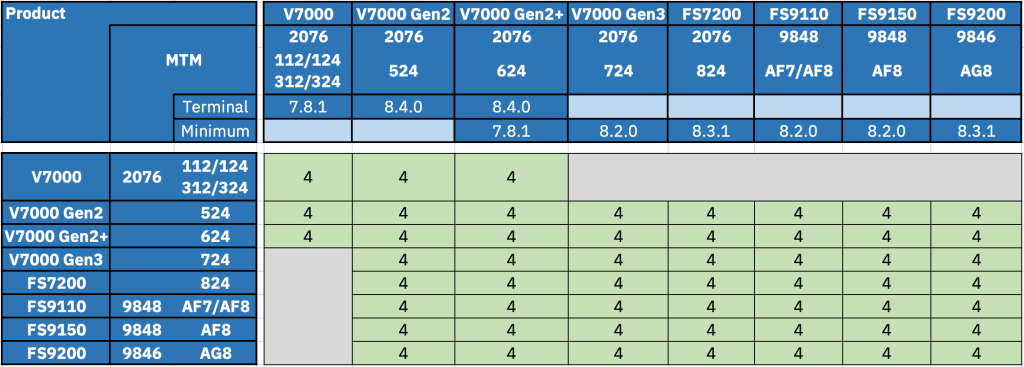
There are some code limitations, particularly if you are adding a newer generation to an existing system, where you need to first ensure the existing system is not only running at least the “minimum” level stated here but also is capable of running the minimum level.
For the 7000 and 9000 table I’ve added two rows (these relate to the column headings as shown in this example)
| Product | YYY | . | |
| MTM | 1234 | ||
| ABC | |||
| Terminal Code | 8.4.0 | ||
| Minimum Code | 7.7.1 | ||
| XXX | 4 |
So here it means product YYY only supports code levels up to and including 8.4.0 (Terminal code) and at a minimum the cluster must be running 7.7.1 to support product YYY (Minimum code)
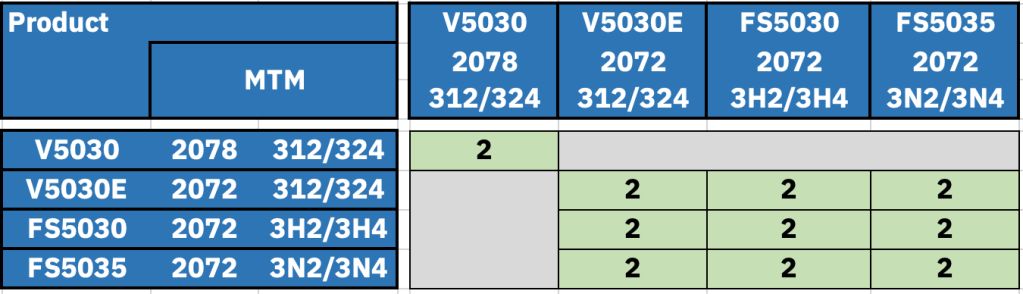
The “4” in the matrix between product XXX and YYY means a cluster can contain up to a total of 4 IO groups of either XXX or YYY etc
IBM Storwize V5030 and FlashSystem 503x Clustering
IBM Storwize V5100 and FlashSystem 5×00 Clustering

IBM Storwize V7000, FlashSystem 7000 and FlashSystem 9000

 Barry Whyte and Andrew Martin : IBM Storage
Leave a reply to Johan Cancel reply